Designing a Drupal application starts with something very simple but foundational: a domain. This is the entry point for all users and should be chosen carefully, keeping branding, SEO, and regional targeting in mind. Along with that, configuring DNS properly with low latency providers and enabling features like DNS caching and geo-routing can already give a small but meaningful performance boost before users even hit your infrastructure.
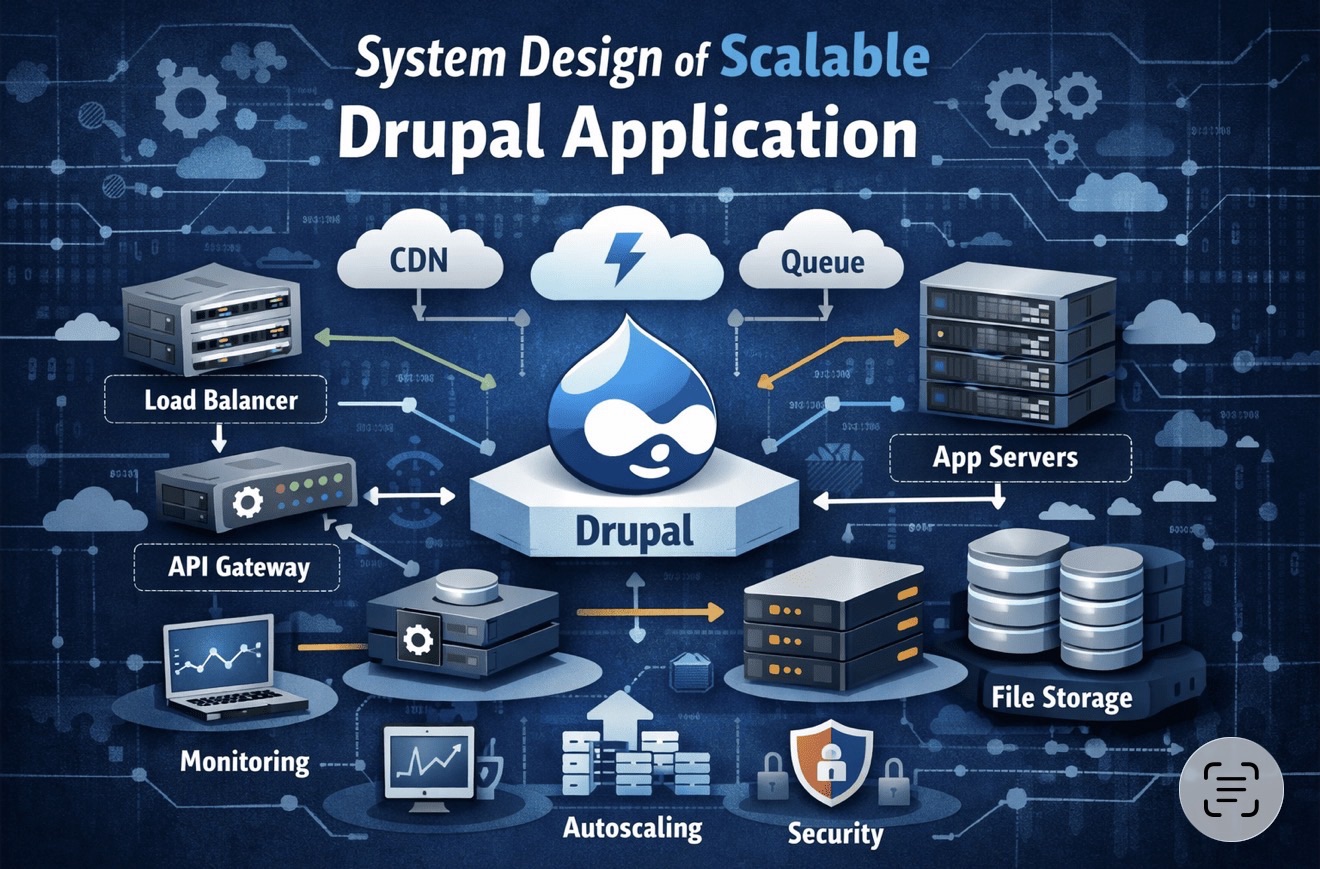
The next layer is the server where your Drupal code lives. This could be a traditional VPS, a dedicated server, or a cloud-based setup using providers like Amazon Web Services, Google Cloud Platform, or Microsoft Azure. Performance enhancements at this layer include using Nginx for better concurrency, enabling PHP-FPM tuning, OPcache for faster PHP execution, and containerization with Docker for consistency. Horizontal scaling through load balancers and auto-scaling groups ensures that traffic spikes do not impact performance. Infrastructure-as-code and automated deployments make the system more reliable and easier to maintain.
The database is the backbone of any Drupal system. Many projects start with MySQL or MariaDB on the same server, which works for smaller use cases. As the system grows, moving to managed services like Amazon RDS or similar cloud offerings improves scalability, reliability, and backup management. Read replicas can be introduced to handle heavy read traffic, and careful indexing along with query optimization ensures consistent performance even with millions of content items.
Filesystem management is another critical part of Drupal architecture. Initially, files may live on the same server, but this approach does not scale well. Offloading files to object storage like Amazon S3 allows for virtually unlimited storage and high availability. When combined with a CDN, media assets are served from locations closer to users, significantly improving load times and reducing pressure on application servers.
Caching is where Drupal systems gain major performance improvements. Integrating Redis allows Drupal to store cache data in memory, drastically reducing database queries. Frequently accessed data such as rendered pages, session information, and cache bins are served from RAM, which is much faster than disk-based access. This leads to improved response times and better scalability under load.
To take caching even further, reverse proxies like Varnish Cache or CDNs such as Cloudflare cache full HTTP responses. Anonymous users can be served entirely from cache without hitting Drupal at all. This dramatically reduces server load and ensures fast global delivery of content.
Search is another area where Drupal benefits from external systems. Native database search does not scale well, so tools like Apache Solr or Apache Tika are commonly used. These provide advanced indexing, faceted search, and content extraction capabilities. Modern implementations are increasingly adopting AI-powered search solutions such as Algolia or Elastic, enabling semantic search and more intuitive user experiences.
AI services are becoming an important part of Drupal ecosystems. Integration with providers like OpenAI enables features such as automated content generation, summarization, tagging, chatbots, and personalization. AI can assist editors directly within Drupal and also power dynamic frontend experiences, especially in headless architectures.
For analytics, privacy-focused platforms like Matomo are often used as alternatives to Google Analytics. These tools help track user behavior and performance metrics. Tag management systems such as Google Tag Manager simplify managing scripts and marketing tags without requiring code deployments.
Marketing automation and CRM integrations extend Drupal into a business platform. Tools like Mautic or Salesforce allow capturing and nurturing leads through webforms, segmentation, and automated campaigns. This ensures Drupal plays a central role in customer engagement and data collection.
Email handling is another essential layer. Platforms like Mailchimp manage campaigns and newsletters, while transactional emails are sent through SMTP providers such as SendGrid or Amazon SES. These services improve deliverability, scalability, and provide detailed analytics.
Beyond the core stack, Drupal can integrate with identity and authentication providers like Auth0 or Okta for secure login systems, single sign-on, and multi-factor authentication. This is especially important for enterprise-grade applications.
Drupal also fits naturally into headless architectures. It can serve as a backend CMS while frontend applications are built using frameworks like Next.js, Nuxt.js, or Gatsby. This approach enables highly performant and flexible user experiences across web and mobile platforms.
For e-commerce use cases, Drupal can integrate with systems like Shopify or Magento, allowing it to handle content while specialized platforms manage products, orders, and payments.
Digital asset management can be enhanced using platforms like Bynder or Cloudinary. These systems provide better control over images, videos, and brand assets, especially in large organizations.
Communication systems such as Twilio enable SMS, WhatsApp, or voice notifications, extending Drupal beyond email-based communication.
Monitoring and observability tools like Datadog, New Relic, and Sentry help track performance, detect errors, and maintain uptime in production environments.
For DevOps and continuous delivery, platforms such as GitHub Actions, GitLab, and Jenkins automate testing, deployment, and release workflows, ensuring faster and more reliable updates.
Translation and localization workflows can be streamlined with tools like Smartling or Lokalise, which are essential for multilingual Drupal implementations.
Payment integrations using platforms like Stripe or PayPal enable subscriptions, donations, and online transactions.
For connecting multiple systems and automating workflows, integration platforms such as MuleSoft or Zapier can be used to sync data across services without heavy custom development.
Drupal is also commonly integrated with enterprise systems like SAP, making it part of a larger business ecosystem where data flows between CMS, CRM, ERP, and other platforms.
From a design and collaboration perspective, Drupal projects typically start with UI and UX designs created in tools like Figma or delivered as PSDs from tools like Adobe Photoshop. Development teams then implement these designs into Drupal themes and components. Project management and collaboration are handled using tools like Jira and Confluence, which help manage tasks, documentation, and ongoing maintenance.
Putting all of this together, a Drupal system is not just a CMS running on a server. It is a layered, highly extensible architecture that connects content, users, marketing, and enterprise systems into a unified platform. The real strength of Drupal lies in its flexibility and its ability to scale from simple websites to complex, enterprise-grade digital ecosystems without requiring a complete rebuild.